How Kerri Walsh Jennings Learned to Love Herself Into Greatness
You can’t critique yourself into greatness. Three golds, one partnership, and a process worth loving.
Kerri Walsh Jennings posted the line on Instagram the way she has always moved through the world—directly, without apology, and with the quiet authority of someone who has already proven the point on the biggest stages. “You can’t critique yourself into greatness. You have to love yourself into greatness.” It is not a soft sentiment. For a woman who spent more than two decades measuring herself against the highest standard in beach volleyball, it is a hard-won operating principle. The same competitive fire that produced three Olympic gold medals, a 112-match winning streak with Misty May-Treanor, and the all-time record for professional beach volleyball victories is still running. It has simply been redirected. These days it shows up in the Rumble Kerri In Training feature episodes she is filming for the NorCal Rumble franchise she co-owns, in the early sessions where she still puts her body through Pilates and strength work, in the deliberate choice to treat the daily process as something worth loving rather than something that must be punished into perfection, and in the expanding platform she is building through Hero Volley.
The line also points to something larger she has lived. Greatness rarely arrives in isolation. The years that turned Walsh Jennings into the most decorated beach volleyball player in Olympic history were built on a partnership that became the clearest real-world lesson in what the right teammate can unlock. That partnership with Misty May-Treanor did not begin as destiny. It began as a conversation between parents in the Olympic Village in Sydney in 2000 and a decision by a tall, dominant indoor player who had consciously avoided the beach because she did not want to look foolish in the sand. What followed was one of the great athletic collaborations of the era, and it still informs how Walsh Jennings approaches the slower, less visible work of building a franchise, mentoring the next group of athletes, and creating spaces where people can fall in love with the game again.
The Path That Built the Standard
Walsh Jennings grew up in the Bay Area in an athletic family. Her father played minor-league baseball; her mother was a standout volleyball player at Santa Clara. She competed in both basketball and volleyball at Archbishop Mitty High School in San Jose, winning state titles in both sports. As a sophomore she once asked a young Misty May for an autograph. At Stanford she became one of the most decorated indoor players in college history—four-time first-team All-American, co-national player of the year as a senior, and the first Pac-10 athlete to reach 1,500 kills, 1,200 digs, and 500 blocks. She helped the Cardinal win NCAA titles in 1996 and 1997. The indoor national team followed. At the 2000 Sydney Olympics she finished fourth with the U.S. indoor squad. The beach became the next arena.
The transition was not automatic. Walsh Jennings has said she had never really played beach volleyball and actively avoided it. After the Sydney Games, her parents sat with Misty’s parents. The idea of pairing the two was raised casually. Walsh Jennings began traveling south on weekends while finishing at Stanford to train with May. The first sessions were not magical. Chemistry took time, and they brought in a coach, Dane Selznick, to help turn instinct into a reliable system. By the end of 2001 they were already climbing. The results that followed are now part of the sport’s permanent record.
The Partnership That Changed Everything
What Walsh Jennings and May-Treanor built together remains the clearest argument for the value of finding a true partner. They were different in energy and approach. Walsh Jennings was the more vocal, expressive presence on the court. May-Treanor was quieter, more lead-by-example. Those differences became an advantage rather than a friction point because both women treated the relationship as something that required deliberate work. They practiced communication. They gave each other permission to make mistakes because the other person was there to cover. May-Treanor has described the feeling of knowing that if she made a bad dig, Walsh Jennings would still go make the best play possible for it. That freedom mattered.
The on-court product looked like a dance. After years of playing together they stopped needing to verbalize every adjustment. Movement and intention aligned. They won the world championships in 2003, 2005, and 2007. At the 2004 Athens Olympics they took gold without dropping a set, becoming the first American women to win Olympic gold in beach volleyball. In Beijing in 2008 they repeated, again without dropping a set, in a final played in a downpour. In London in 2012 they completed the three-peat. Across those three Games they won 21 consecutive Olympic matches and lost only one set in the entire span. Between 2007 and 2008 the pair posted a 112-match winning streak and 19 consecutive tournament titles. They finished their partnership with more than 100 victories as a team. Walsh Jennings ended her career with 135 international and domestic wins overall, the all-time record.
The partnership was never frictionless. There were arguments. There were stretches when life intervened—pregnancies, injuries, May-Treanor’s Achilles injury during a run on Dancing With the Stars, periods when they played with other partners. After one such stretch they met for lunch and had a direct conversation about whether both were fully committed again. Walsh Jennings has called it one of the best conversations she ever had with May-Treanor. Trust was rebuilt. They returned and won the third gold. In interviews both women have emphasized the same elements: respect for differences, shared goals, honest communication, and the decision to celebrate the work along the way rather than waiting for the final result. Walsh Jennings has said they always stuck together, even on the rare occasions they lost. When things got hard, they came toward each other instead of separating.
That is the practical lesson. Talent is necessary but not sufficient. The right partner multiplies what either person can do alone by creating trust that survives pressure, by covering weaknesses without judgment, and by turning the daily grind into something both people are willing to keep choosing. Walsh Jennings has carried the same principle into the rest of her life. She has described her marriage to fellow player Casey Jennings in similar terms and has spoken about the necessity of support systems once she became a mother of three. The Rumble project and Hero Volley now ask her to build that same kind of partnership at a larger scale—with co-owners, with staff, with athletes, and with communities that may not yet see themselves as part of the sport.
What the Rumble Kerri In Training Episodes Actually Show
The major premise of her current chapter is visible in the Rumble Kerri In Training feature series she has been releasing for the NorCal Rumble franchise. NorCal Rumble is the Major League Volleyball expansion team she co-owns as Founding Owner and Chief Impact Officer. The club will begin play in 2027 at Tech CU Arena in San Jose. Ownership partners include Theresia Gouw and Vivek Ranadivé, with additional investors such as Andre Iguodala. The brand identity draws on Northern California’s natural forces—relentless like the tides, grounded like the redwoods—and Walsh Jennings has framed the project as a place where athletes are encouraged to trust their own instincts rather than perform a version of themselves for external approval. She has said she wants people to listen to their inner Rumble and step toward it.
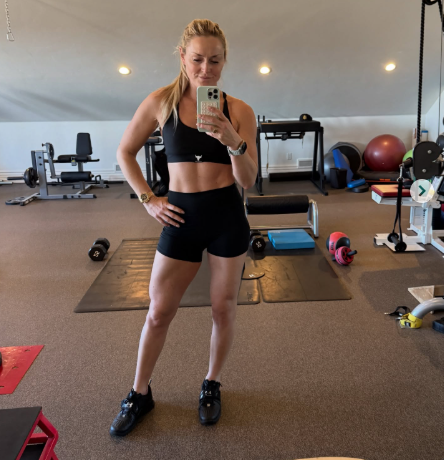
The In Training episodes function as extended, behind-the-scenes documentation of that process. They show her still training, not as a retired icon making ceremonial appearances but as someone who continues to log the work while simultaneously building the infrastructure around the team. Viewers see the sessions that emphasize mobility and strength so she can move well at 6-foot-3 and still in her late forties, the conversations about culture and standards with staff and future players, and the unglamorous logistics of launching a professional franchise. The series is not polished highlight reels. It is process footage: the early mornings, the soft-tissue work, the moments when the body does not feel ideal and the choice is still to show up without turning the day into a referendum on self-worth.
That distinction is the point she keeps returning to. In recent interviews and the framing of these episodes, Walsh Jennings has described a shift from treating every hard moment as a test that must be passed to treating it as a rep that can be executed cleanly and then released. She has said she used to live with anxiety because everything felt like an evaluation. Now she looks for ways to love the pursuit itself. The Rumble episodes make that philosophy concrete. She is not critiquing the early-stage franchise into existence; she is investing attention, physical capacity, and organizational energy into it because the work itself is worth doing. The same approach that once sustained a 112-match streak with the right partner is now sustaining the slower work of building something that did not previously exist in the Bay Area.
Hero Volley: Making the Sport Something People Want to Love
Alongside the franchise work, Walsh Jennings has made Hero Volley a central expression of the same idea. What began as a multi-day beach volleyball experience in Montauk—centered at Hero Beach Club—has grown into a platform that deliberately mixes elite competition with accessibility, wellness, and community. Co-created with Josh Brussell, the event series brings professional athletes, rising talent, local players, and newcomers onto the same sand for clinics, pro-am tournaments, wellness sessions, and celebrations. Youth and adult clinics teach technical skills while also emphasizing how elite athletes approach training, challenges, communication, and mindset. A portion of proceeds supports the Hampton Lifeguard Association and local water-safety efforts. The event has expanded programming and returned for multiple years, with additional activations that have taken the concept beyond a single location.
Walsh Jennings has been clear about the intent. Youth sports have become increasingly organized around year-round schedules, rankings, and high-pressure performance. That environment can leave less room for the simple joy that first drew people to the game. Hero Volley is designed as a corrective. Pros coach and play alongside amateurs. Locals share the court with Olympians. The atmosphere prioritizes connection and the pleasure of movement rather than pure evaluation. She has described it as building a community experience instead of a passive spectator event, and as a way to bring the sport that shaped her life into places and audiences that may not otherwise encounter it at a high level. In interviews she has linked the project to a larger desire to create more consistent opportunities for athletes to compete, earn, and build while still protecting the love of the work.
The platform sits naturally next to her other efforts. p1440, the youth-focused organization she co-founded with her husband, addresses development, scholarships, recovery, nutrition, and mentorship. NorCal Rumble builds the professional infrastructure. Hero Volley supplies the living, public expression of the culture she wants those systems to support—one in which athletes and participants are encouraged to trust their instincts, show up fully, and love the process rather than critique themselves into a version of greatness that feels punishing. The Rumble In Training episodes and Hero Volley events together show the same person applying the partnership lessons she learned with May-Treanor at a larger scale: shared vision, honest communication, and the willingness to cover for each other while the work is still unfinished.



Training That Still Fits the Life
Walsh Jennings has never treated fitness as optional. During her competitive peak she typically logged multiple sessions a day: beach practice of two to two-and-a-half hours, followed by Pilates, track work, or fast-twitch strength training, plus mental skills work. Pilates was a consistent through-line for core strength, balance, and post-pregnancy recovery. She has worked with trainers on Olympic lifting, circuit-style strength, and extensive mobility for the thoracic spine and hips. Soft-tissue work, ice when needed, and deliberate recovery were part of the daily structure. She has also spoken about the mental side—giving her brain a simple job under pressure, such as spelling a word, so anxiety has less room to expand.
The current version is more integrated into daily life than periodized around a tournament calendar, but the principles remain. She lifts weights three or four times a week and emphasizes staying long and mobile at her height. Lagree Pilates and traditional Pilates sessions appear regularly; she has called Lagree one of the most humbling workouts she has done because of the volume of bodyweight she moves on the machines. Soft-tissue work with a foam roller, lacrosse ball, or similar tools is standard. Sleep is non-negotiable—she aims to be in bed by 10 p.m. so the recovery quality is high. Lemon water in the morning, consistent protein and greens, and tools that support circulation round out the practical side. The Rumble In Training episodes and the Hero Volley clinics capture pieces of this routine in real time rather than in idealized form.
A practical session that IDNTY users can adapt draws from the mobility, core, and strength elements she has long prioritized:
Warm-up and Mobility (10–12 minutes)
Light cardio to raise temperature, then dynamic movements: leg swings, hip circles, thoracic rotations, and shoulder openers. Spend extra time on hips and thoracic spine—areas that absorb high volumes of jumping and rotational stress in volleyball.
Pilates-Inspired Core Circuit (3 rounds)
Pilates Hundred variation: lie on back, legs at tabletop or extended low, lift head and shoulders, pump arms for 10 full breath cycles (inhale 5 pumps, exhale 5).
Forearm plank or side plank: 30–45 seconds each.
Dead bug or bird-dog: 8–10 controlled reps per side, emphasizing slow movement and core stability.
Strength Circuit (3–4 rounds)
Goblet or bodyweight squat: 10–12 reps.
Push-ups or elevated push-ups: 8–12 reps.
Reverse lunges or walking lunges: 8–10 per leg.
Single-arm row or TRX row if available: 8–10 per side.
Optional finisher: medicine-ball or wall toss rotational throws, or short sand-sprint intervals if beach access exists.
Rest 60–90 seconds between rounds. Finish with 5–10 minutes of soft-tissue work and static stretching focused on hips, hamstrings, chest, and shoulders. The emphasis is quality of movement and recovery capacity rather than maximal load. Pair the session with the same standard Walsh Jennings applies to the larger work: execute cleanly, recover fully, and do not turn an imperfect set into evidence against yourself.


The Playbook
1. Treat hard sessions and imperfect days as reps rather than tests. Execute cleanly, then release the result.
2. Protect sleep as the foundation that makes every other training decision sustainable.
3. Pair strength work with dedicated mobility and soft-tissue sessions so the body stays capable of the ranges the sport (or life) demands.
4. Use the process itself as the measure of progress when external metrics are no longer the primary scoreboard.
5. Ask for help and build systems early; isolation is not a requirement of high performance.
6. Document or share the real work when building something new—visibility into the process often matters more than polished outcomes.
7. Choose language and standards that expand capacity rather than shrink it. Critique alone does not produce the next level.
8. Invest the time required to find and maintain the right partner. Trust, shared vision, and the willingness to cover for each other under pressure are not automatic; they are built the same way any other skill is built.
9. Create spaces where people can love the work again. Platforms like Hero Volley show that joy and high standards are not opposites.
Five Verified Quotes
“You can’t critique yourself into greatness. You have to love yourself into greatness.”
“I used to think everything was a test and my life was full of anxiety and stress. Now I think of everything as a rep.”
“The process is a beautiful thing, and I love it. I’ve just forgotten that I love it.”
“My job is to be fit and I’m really blessed that I get to go and work out and live a really healthy lifestyle.”
“Adversity, if you allow it to, will fortify you and make you the best you can be.”
Walsh Jennings built one of the greatest careers in Olympic beach volleyball by meeting the highest standards on the sand, through injury, pregnancy, partnership changes, and the internal pressure that comes with being the best. The years with Misty May-Treanor demonstrated, more clearly than almost any other athletic collaboration, that the right partner multiplies what either person can achieve alone. The chapter now unfolding in the Rumble Kerri In Training episodes, the NorCal Rumble build, and the Hero Volley platform shows the same person applying a refined version of that standard to a different kind of work. The medals proved what was possible under the old framework. The current work is demonstrating what becomes possible when you love the process, protect the relationships that make the hard days survivable, create spaces where others can fall in love with the game, and refuse to critique yourself into the next result. The partnership lesson travels. So does the training. Both remain available to anyone willing to treat them as something worth choosing every day.
Ready to Train Like a Champion?
Unlock world-class training built for athletes who keep showing up for the next chapter.
Unlock the App