Peyton Manning Never Stopped Calling Audibles. Neither Should You
A fused neck, a second franchise, a second ring and a second career built on one habit.
Fourth quarter, Super Bowl 50, Levi’s Stadium. Peyton Manning stood behind center at 39 years old with a surgically fused neck, a right arm that had lost the zip it carried in Indianapolis, and a left foot still sore from a torn plantar fascia that had cost him half the season. Carolina’s defense was the best in the league. The play came in, Manning looked over the formation, and he did what he had done roughly ten thousand times before. He pointed. He barked. He changed it. Denver won 24–10, and Manning became the first quarterback to win Super Bowls with two different franchises.
The win was not about arm talent. By that night the arm was the least interesting thing about him. It was about a habit he had built over two decades: see the real picture faster than anyone else, prepare so thoroughly that changing the plan feels like an option instead of a panic, then make the call and own it. Four years later, when he started a production company, he named it after the most famous word he ever yelled at a line of scrimmage. Omaha.
The Middle Son Who Had to Earn the Huddle
Manning was born in New Orleans in 1976, the middle son of Archie Manning, an NFL quarterback, and Olivia Manning. His older brother Cooper’s football path ended early because of spinal stenosis. His younger brother Eli would later win two Super Bowls with the Giants. Peyton did not play organized football until seventh grade. At Isidore Newman School he became one of the most coveted high school quarterbacks in the country, and still, when he arrived at the University of Tennessee, nobody handed him the room.
In his Hall of Fame speech he told the story of an early huddle in Knoxville. He started to call a play and a big senior offensive lineman cut him off and told him, more or less, to shut up, because he had not earned the right to talk yet. Manning never forgot it. Respect in a huddle was not a function of last name or draft stock. It came from preparation that everyone could see. He went on to become a consensus All-American, win an SEC title, and finish as Heisman runner-up. The Indianapolis Colts took him first overall in 1998.
Thirteen Seasons of Making Defenses Blink
For 13 years in Indianapolis, Manning was the franchise. He won a Super Bowl after the 2006 season, collected four of his five MVP awards there, and turned the week of preparation into a competitive weapon. He studied film until he could predict a coverage by how a safety set his feet. He installed so many checks at the line that defensive coordinators started disguising later and later, which was exactly what he wanted, because a defense guessing at the snap is a defense reacting rather than dictating.
He was also durable to the point of absurdity. Across those seasons he missed one snap to injury. Then his neck gave out.
The Year Nobody Was Allowed to Watch
The nerve problems in his neck had been building, but in 2011 they became decisive. Manning underwent multiple procedures, including a spinal fusion, and sat out the entire season. The weakness in his throwing arm was so pronounced that he limited who could watch him practice. Only his wife Ashley, his brother Eli and his father saw those early sessions. Imagine one of the most precise passers in history fluttering throws ten yards and deciding that, for now, the fewer witnesses the better.
The Colts had the first pick in the draft and Andrew Luck waiting. They released Manning in March 2012. He was 36, and the prevailing opinion was simple: finished. He signed with the Denver Broncos instead and rebuilt his game around what his body could still do: quicker reads, earlier throws, more pre-snap manipulation and less reliance on velocity. In his first season in Denver he threw for nearly 4,700 yards and 37 touchdowns. In 2013 he set single-season NFL records for passing yards and touchdowns and won his fifth MVP. The physical tools had changed. The ability to adjust without giving up control had not.
The Second Chapter Got the Same Film Study
After he retired in 2016, Manning took his time. He did not want to coach. He turned down conventional broadcast booth offers. With Jamie Horowitz he founded Omaha Productions, and the company became the place where he could stay on a team without being the quarterback every Sunday. Omaha produces the ManningCast, the alternate Monday Night Football broadcast on ESPN he hosts with Eli, which has won Sports Emmy Awards. It made Netflix’s Quarterback and Receiver, the Places franchise and the scripted series Chad Powers on Hulu. Manning has called it a second chapter and has said he wants his kids to see him going to work.
He also invested early in athletic training. Will Bartholomew, a teammate at Tennessee whose playing career ended with a knee injury, founded D1 Training in Nashville. Manning became a partner in multiple Tennessee locations beginning in the mid-2000s and stayed involved as the brand expanded nationally. The pattern is the same one he ran at the line: find people who understand the standard, build systems that help other people improve and stay close enough to the work that the principles do not get watered down.

Four Days in Thibodaux
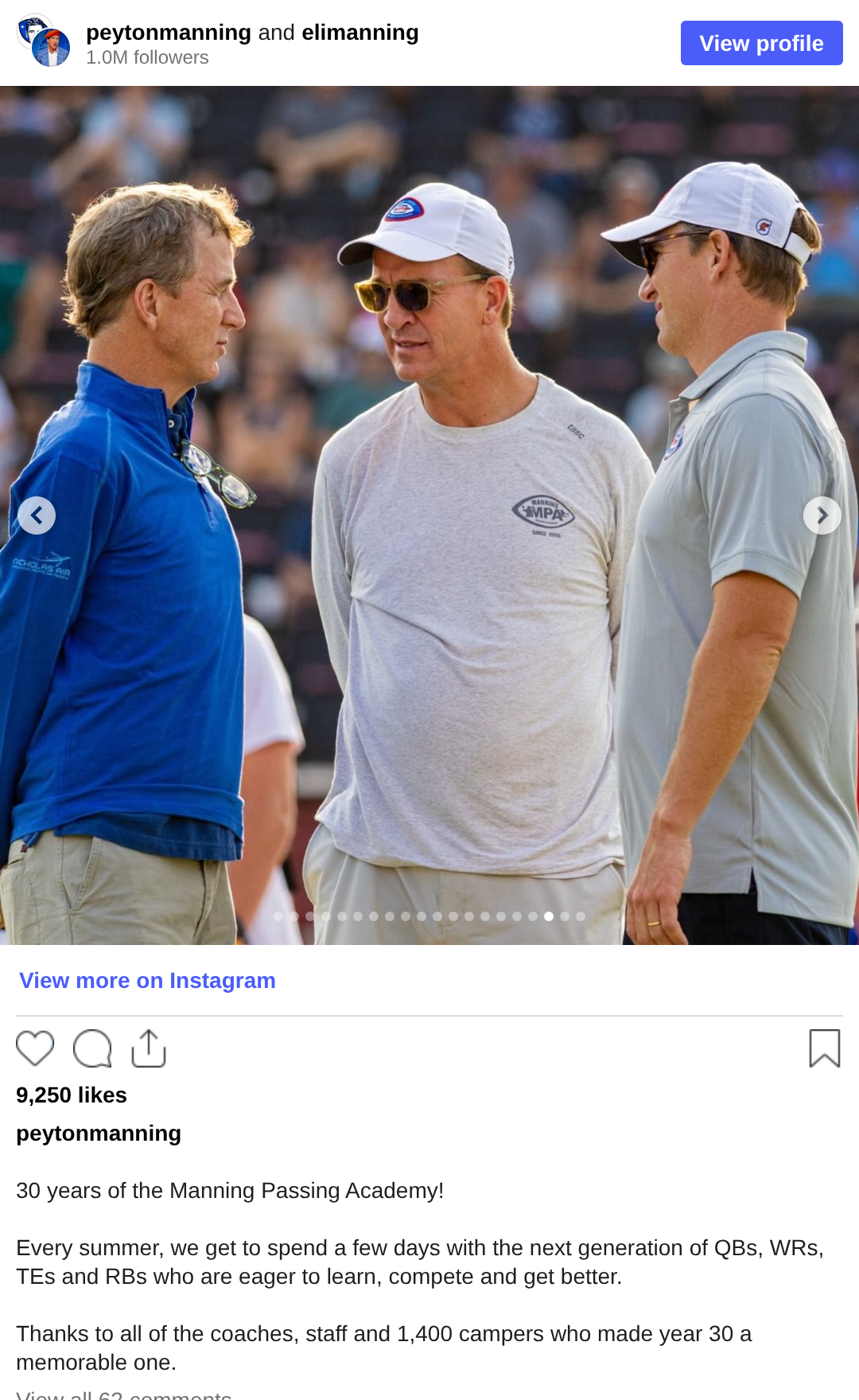
The oldest of those systems is the Manning Passing Academy. In the mid-1990s, while he was still at Tennessee, Peyton went to a quarterback camp run by Bobby Bowden and his sons. He came home convinced that Louisiana high school football was not teaching the passing game well. Too many 35–3 scores, too many quarterbacks going three for five on the night. He told his father they should start something better. The first academy was held at Tulane in 1996 with roughly 200 campers.
It moved to Southeastern Louisiana and then, in 2005, to Nicholls State in Thibodaux, where it has stayed. It now draws more than 1,400 high school quarterbacks, receivers, tight ends and running backs. College starting quarterbacks work as counselors. Archie, Cooper, Peyton and Eli are there every summer, first to arrive and last to leave. Archie likes to say it guarantees him four days with his sons. Nobody is trying to manufacture superstars. The point is fundamentals, leadership and helping kids love the game more than they did when they showed up.
Golf, Biscuits and the Long Game
Golf has become the way Manning stays moving and competitive now that the calendar no longer does it for him. He is a member at Augusta National, Cherry Hills and Castle Pines, carries a handicap that has hovered in the mid-single digits and plays pro-ams like the Memorial and the BMW Championship. He partnered with Tiger Woods against Tom Brady and Phil Mickelson in The Match in 2020. Golf gives him hours outside, rotational movement without training-camp joint stress and competition that still matters on a Saturday. He has said it was already part of offseason bonding when he played, because NFL rules limited time in the building. Retirement just gave it more room.
He was never the guy with the immaculate meal plan. Brady has told the story of a 2010 offseason breakfast in Tennessee. Brady ordered oatmeal and two scrambled eggs. Manning ordered biscuits and gravy, three pancakes, six pieces of bacon and three sausages. Brady asked whether he was actually going to eat all of that. He was. Manning did not treat the plate as his main longevity lever. He leaned on preparation, film, recovery and the discipline to adjust when his body changed. That is not a recommendation to order the sausage. It is a reminder that longevity tends to come from the process you will actually keep, not the one that looks best on paper.
At home he is the father of twins, Marshall and Mosley. Marshall is a freshman backup quarterback at Baylor School in Chattanooga and already holds scholarship offers from programs including Ohio State and Miami. In early October, coming back from a foot injury, he led a touchdown drive in a rout of rival McCallie, going three for four for 35 yards. His father was in the stands. Not on the sideline, not in his ear. Just watching. For a man who spent his career taking over the line of scrimmage, that might be the hardest audible of all.
The Audible Workout
This session is built around Manning’s operating system: move well, own the positions and then review the tape. It needs little more than a dumbbell or kettlebell and a phone.
Warm-up (8–10 minutes). Light movement to raise your temperature, then hip openers, band pull-aparts or arm circles and a few bodyweight squats and lunges. Arrive at the main work able to move cleanly, not already tired.
Strength and control circuit (3–4 rounds). Goblet or bodyweight squat, 8–12 controlled reps to a depth you can own. Push-ups or elevated push-ups, 8–12 reps. Reverse lunges or split squats, 6–10 per leg. Plank or dead bug, 30–45 seconds or 8–10 slow reps, resisting movement instead of rushing it. Rest as needed to keep quality high, then finish with five minutes of easy walking or mobility.
The film session. Set your phone up and record one clean set of the circuit, or a short section of a presentation you are preparing. Watch it right away. Find one specific thing that looked or sounded different from what you intended, whether that is tempo, posture, a filler word or a rushed transition. Fix that one thing and record one more take. The goal is not to pick yourself apart. It is the same loop Manning ran for years: see the real picture, make one precise change and confirm it held. Most people skip the film. The people who keep getting better usually do not.
The Manning Playbook
Prepare until changing the plan feels like an option, not a crisis.
Earn the huddle every day. Your title does not buy respect, but visible preparation does.
Film the things that matter, whether a lift, a pitch or a hard conversation, and make one specific adjustment.
When the body changes, rebuild around what still works instead of mourning what does not.
Pick a sport you can play for decades. For Manning it is golf. Movement plus competition plus people is a powerful combination.
Build or join something that makes other people better, because the most valuable player makes everyone else more valuable.
Stay coachable. He has said he gets angry when he is not coached.
In His Words
“Pressure is something you feel when you don’t know what the hell you’re doing.”
“I love being coached. I get angry when I’m not coached.”
“The most valuable player is the one who makes the most players valuable.”
“I never left the field saying I could have done more to get ready.”
Two Super Bowls, five MVPs and a permanent place among the greatest quarterbacks who ever lived. The useful part for the rest of us is underneath the trophies. Manning prepared until the adjustment was available, and when the situation changed he called it, whether that meant leaving Indianapolis for Denver, naming a company after a word he yelled at defenses or sitting in the stands while his son took snaps as a freshman backup. Your situation is going to change too. Do the work that makes the next call possible. Then call it. Omaha!
Ready to Train Like a Champion?
Unlock world-class training built for athletes who keep showing up for the next chapter.
Unlock the App